BLOG
The Chernobyl Exclusion Zone and its Limits: Metahaven, Radioactive Transversality and Anthropogenic Failures to Contain.
Esej uniwersytecki · Historia sztuki
An English-language university essay on the Chernobyl Exclusion Zone, Metahaven, radioactive transversality and the limits of anthropogenic containment.

In Felix Guattari’s groundbreaking ecosophical 1989 work ‘The Three Ecologies’ Guatarri proposed a new era of ecological discourse in which the nature:culture distinction can no longer be separated and that humanity must now begin to think about environmental issues transversally.1 One of the events signaling this transversal ‘turn’ was the 1986 Chernobyl disaster in which nuclear reactor No.4 of the Chernobyl Nuclear Power Plant exploded, emitting lethal doses of radiation all across Ukraine, Belarus and many other nations situated within Eastern Europe Soviet blocs. For this essay I will not only be examining Deep Ecology notions of transversality, but also how radiation particles transverse geopolitical borders, erasing anthropogenic logics of containment and exclusion. In conjunction to this, Metahaven’s 2018 ‘Version History’ exhibition provides a reference point for ways in which zones can be transversed and their illumination on the Chernobyl aftermath helps explicate ways in which technological acceleration can be surpassed by ecological calamity. Their multimedia exhibition merges information on Chernobyl with Andre Tarkovsky’s movie ‘Stalker’ and also fictional cartography as a means of deciphering the semiology of zones as both geographical and geopolitical sites. Additionally, I will be analysing the motion of gamma rays through the writing of Deep Ecologist Timothy Morton to help meld a non-anthropocentric analysis of how nonhuman substances interact with and disavow human logics of confinement.
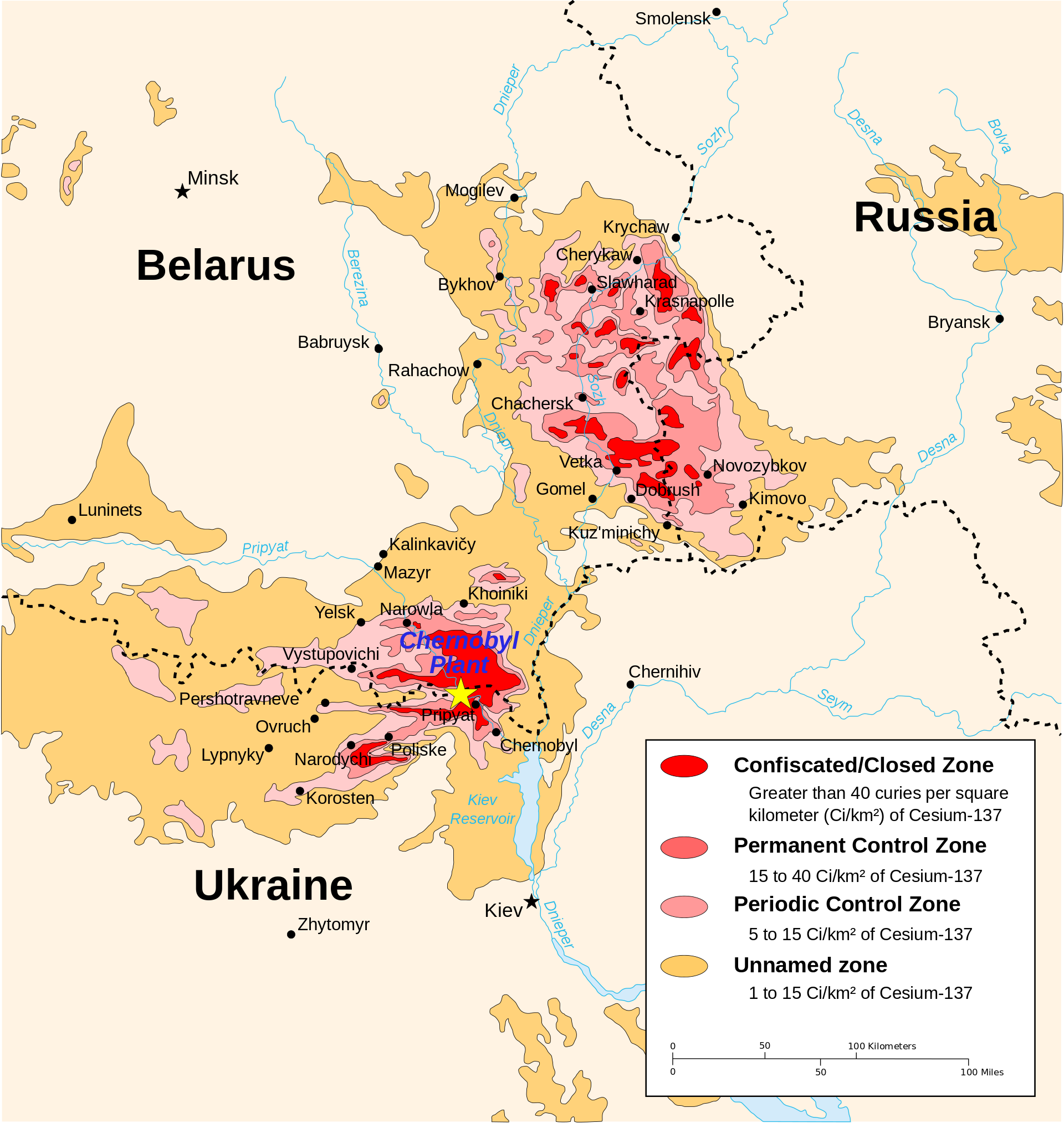
After the explosion at Chernobyl’s reactor No.4 based at the northern pinnacle of Ukraine, Ukraine’s ‘Ministry of Emergency’ declared a 30km zone of alienation surrounding the reactor: the Chernobyl Exclusion Zone, a mass comparable to that of Greater London’s circumference. Following this delineation, over 500,000 citizens were displaced and three other zones differing intensities of the levels of cesium, strontium and plutonium were created around the perimeter of the Exclusion Zone.2 As (fig.1) explicates, high volumes of radiation seeped into Ukraine’s neighbouring countries Belarus and Russia, alongside other Eastern European nations being subjected to lower volumes of contamination. The Ministry of Emergency’s failures to contain the radiation were highlighted in the region of Belarus where “23% of the territory” of the nation “was contaminated with long-living radionuclicides.”3 Despite Belarus not possessing a single nuclear reactor in the entire nation, “a fifth of the nation’s 10 million population now lives on contaminated land.”4 Resulting from this transnational radioactive seepage, many theorists developed a pessimism surrounding humanity’s capabilities at accelerating nuclear and other technological expansions in the face of risking further ecological calamity. For Ulrich Beck, Chernobyl’s explosion was so catastrophic that it signaled the “beginning of a social construction of risk realities.” Chernobyl, meeting at the nexus of rivaling Cold War politico-scientific technologisation and ecological devastation, Beck emphasised how the anthropocene is now evermore encroaching through the precarious emergence of a new set of risk factors that can potentially hinder the vitality of the world’s ecosphere alongside humanity in itself. Despite radiation transversing Ukraine’s national boundaries, the Ministry of Emergency promoted an “image of containment [that] was partially achieved through selective resettlements and territorial delineations of contaminated zones.”5 By producing a veneer of containment, the disaster appears resolved despite this resettlement and zone curtailment occurring solely in northern Ukraine. Moreover, the centralisation of authority designating zones’ perimeters rely on a fixed law of determinism in which at a certain threshold areas of land are officially deemed uninhabitable, despite radiation still persisting elsewhere. For Sigi Jottkandt, the zone is symbolically reliant on a logic of exclusion, where its very name suggests that it is a geopolitical site of containment.6 In Jottkandt’s words, “in Chernobyl’s Exclusion Zone, the Symbolic – understood as a signifying order founded on a limit would have been entirely erased.”7 This limit according to Jottkandt entails an “intermediary threshold, a mobile ‘membrane’ coordinating nodes of relations”8 through an “operation of multiplication and division to a topological transformation.”9 Since many lay people lack the scientific tools such as Geiger counters to measure such hazardous changes within the ecosystem, the quantification of radiation can only be ascertained by “scientific and administrative knowledge.”10 Therefore, the symbolic zones themselves signify where excessive volumes of radiation reside as a parameter for confinement. Although noticeably, many affected areas of Belarus, Ukraine and Russia have not been delineated despite their inhabitants also being subjected to high volumes of radiation, attesting to how the zones themselves are not of an exceptional and confining nature but merely exists to exclude human populations.
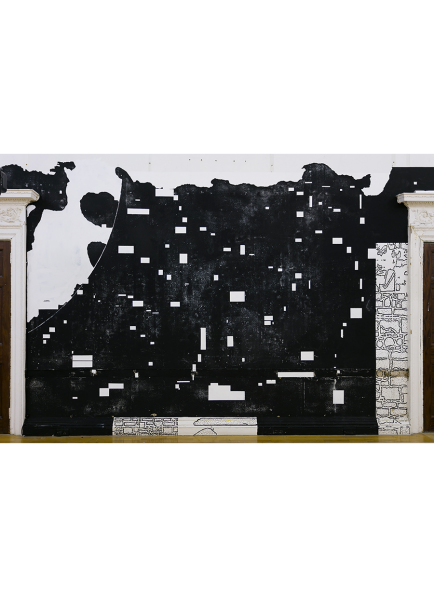
Metahaven’s 2018 “Version History” exhibition at the ICA heavily contemplates on discourse surrounding transverality and the limits of zones as anthropogenic geopolitical paradigms. Alongside video works such as “Eurasia” addressing cross-continental nomadism and travelling, the atmosphere created through their immersive wallpaper artworks spread across all three rooms of the exhibition display a fictional landscape in which zones are cordoned off through cartographic delineations. The wallpapers themselves are also named “Version History” and take direct reference from the radiation mapping that occurred after the Chernobyl disaster. (fig.2) shows a minimal black and white map of an area of land in which a circular radius is dominating the map as if it was a zone created to designate the circumference around the point of a nuclear explosion. Alike to Ukraine’s Ministry of Emergency’s failure to contain the seeping of radioactive contamination, the exact circular shaping of this zone in Metahaven’s “Version History” exemplifies failed human attempts at containing such contamination as a nuclear disaster would not result in a circular radius of contamination per se due to the variables affecting the movement of gamma rays such as wind and heat levels within the environment. This influx and transversality of radiation is what Steve Matthewman describes as being “difficult to contain or demarcate”, labeling the Chernobyl Exclusion Zone as an “ill-defined territory” precisely because of this existential failure to contain the constantly flowing radioactive matter.11 In conjunction, another wall of the artwork (fig.3) depicts zones, which appear hidden through the white marking of their proximities in rigid cubic shapes. Although this particular cordoning appears to have more commonalities with state military-industrial clandestine operations as opposed to delineations of ecological calamity, the cordoning similarly reifies how States attempt to cordon off sections of land is in part an attempt to contain what is often imperceptible to others. In Metahaven’s leaflet for their “Future of the Zone” symposium to the ICA ‘Version History’ exhibition, zones are described as “an enclosed sector in which the exceptional happens. Originally conceived as a 'belt' or 'girdle,' it applies to geoengineering and geospatial design as much as to the notion of the accident.”12 By focusing on the topological mechanics of the zone, Metahaven describe how zones are static spaces of confinement in which accidents can hypothetically be contained. Though as radiation proves, static boundaries are limited, as they are only effective anthropocentrically as a means of preventing humans from entering the perimeter, whereas radiation is still freely flowing.
When Guattari wrote that Chernobyl has “dramatically revealed to us the limits of humanity’s techno-scientific power and the ‘backlash’ that nature has in store for us,”13 he was directly addressing how human manipulation of naturally occurring hazardous substances such as gamma radiation is incapable of being confined by human technologies due to the risks of contamination and explosions. Since the Chernobyl Exclusion Zone is an officiated site of ‘exception’ situated within the enclaves of Ukraine’s national geopolitical zone, Guattari argues that territories such as the Chernobyl Exclusion Zone “threaten the consistency of both individual and group existential Territories,”14 due to its alienatory delineations, infringing on human settlements. Furthermore, since the Chernobyl Exclusion Zone presupposes a law of containment, the leakage of radiation de facto undermines its existence. A zone in itself is a symbolic site of exception and for Guattari likewise to Jottkandt, can only semiotically exist through a collective assemblage of “subjective enunciation” in which humans auto-poetically reaffirm the zone’s existence. For instance, in regards to the Chernobyl Exclusion Zone, this collective assemblage of subjective enunciation is reaffirmed through the presence of border guards, Geiger counters signaling radioactive levels and biological proof of radiation contamination upon the local populous, reifying the zone’s use value and existence. Additionally, what makes this symbolic zone a specifically subjective designation, is due to the Ministry of Emergency’s rationale of what volume of radiation they believe is uninhabitable for humans. Antithetically many species of animals and wildlife are scientifically proven to be flourishing within the Chernobyl Exclusion Zone due to the absence of human settlers, reinstating how the zone’s subjective enunciation is based on the safeguarding of humans as opposed to the rest of the animals and wildlife.15
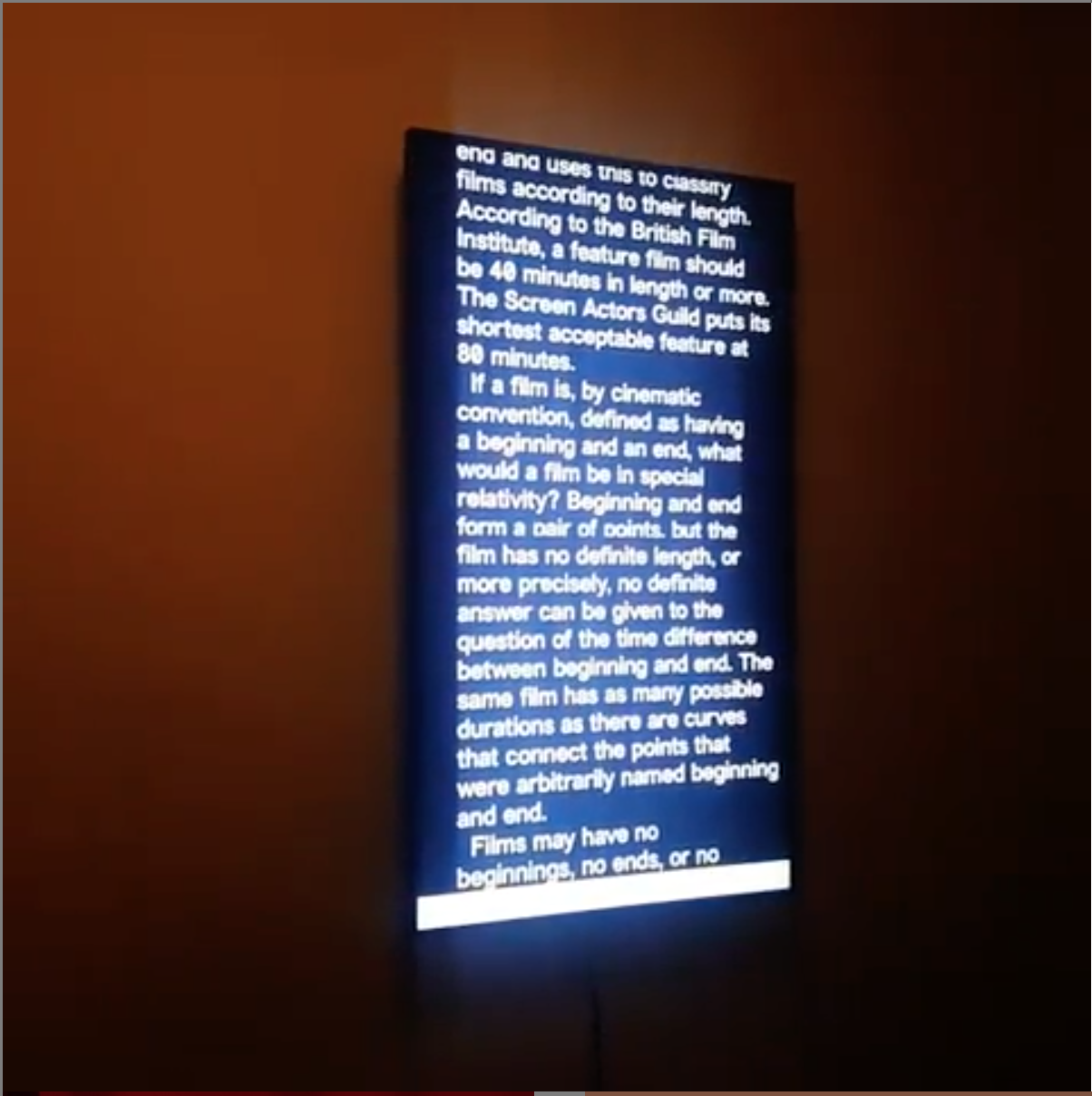
Metahaven’s accompanying essay for ‘Version History’ entitled ‘Digital Tarkovsky’, contemplates on the transversal deterritorialisations of land that arose in the aftermath of the Chernobyl disaster. Projected off a screen scrolling down at the back of the ICA canteen (fig.4) Metahaven have detailed the ways in which the Chernobyl disaster reshaped the geopolitical ecology of its affected radius, as “the zone is not a country”16 but “can be understood as part of an “internal deterritorialisation of Soviet culture during the period of late socialism”.17 Despite the USSR still existing during the 1980s as a unified state, Metahaven stress how Chernobyl’s disastrous effects not only physically contaminated populations of people, animals and wildlife, but created a great discontent from individuals towards the USSR’s capabilities of securing their nuclear technologies from further outbreaks. ‘Digital Tarkovsky’ also direct parallels between the Chernobyl disaster and Andrei Tarkovsky’s 1979 Mosfilm production ‘Stalker’ so much so that “Stalker realised its visions so uncompromisingly that it would come to be seen as a prediction for the Chernobyl nuclear disaster”18. Tarkovsky who had coincidentally died in 1986 the same year as Chernobyl had based his film on a book written by the Strugastgy brothers called ‘Roadside Picnic’.19 In ‘Stalker’, Tarkovsky envisions a mysteriously enigmatic zone in which armed soldiers occupy the perimeter, preventing any trespassers from entering. Similar to the Chernobyl Exclusion Zone, this territory possesses a symbolic law in which hazardous otherworldly phenomena occurs, a place heterogeneous in nature to its exterior. However, despite the zone’s cordoning off from trespassers, its contaminants likewise transverse its confines and as for the protagonist’s daughter named ‘Monkey’, she was born disabled by the zone’s contamination despite not having ever entered its perimeters. Metahaven’s comparison between the effects of Chernobyl and Monkey’s disability highlights how zones as symbolic sites of confinement become trivialised when its confines are no longer purely contained within it and are physically able to transverse the logical boundaries of the zone itself.
Tarkovsky’s ‘Stalker’ is similarly cross-reference in In Metahaven’s 64-minute video installation ‘Eurasia’ for ‘Version History.’ The video artwork fuses videography filmed by Metahaven of Siberian steppes with gameplay from the 2007 Ukrainian-made computer game ‘S.T.A.L.K.E.R. (Shadow of Chernobyl).’ The game ‘S.T.A.L.K.E.R.’ intersects the plotline from Tarkovsky’s ‘Stalker’ with the reconstruction of the Chernobyl Exclusion Zone “in which locations from the film were freely adopted and then electrically combined with the nuclear reactor.”20 By overlaying a physical Siberian environment with an electronically simulated version contrasts how technology has transformed the environment into a purely anthropocentric realm of cybernetics, hinting at how the anthropocene has permanently altered the world’s ecosphere into a transversality of Guattari’s nature:culture unification. Rethinking Chernobyl’s ecological calamity through computer game software somewhat reflects upon the technologically accelerationist aspects of the USSR’s nuclear program during the 1980s through the simulation of the Chernobyl Exclusion Zone’s post-nuclear ecosphere. Moreover, since radiation exists for centuries, the use of digital media stresses the burden radiation has for the future of humanity. The exhibition leaflet details the “geographic and geopolitical” region of Eurasia as a site of “hyper-fragmentation” of which varying political orders and landscapes heterogeneously reside. In the video, ‘Eurasia’s’ inhabitants are described as extraterrestrial, not belonging to a single state, but transversing borders by existing liminally between different states of post-Soviet former territories. The video reads, “The re-natured environment is virtual, awakened, alive – and the ultimate horizon of Eurasia opens out,”21 emphasising how within the digital realm human geopolitical borders become diminished through global cybernetic connectivity and how the Internet in itself is transversal as it is has no set location of residence. This comparison between radiation and the Internet relates in a very understandable manner, as alike to gamma rays, radio waves are a form of electromagnetic radiation.22
When thinking ‘transversally’ in regards to the political ecology of the Chernobyl Exclusion Zone as a site of alienation and confinement, it is tantamount to investigate the constant flux and redistribution of gamma ray particles within the ecological environment. Writing on gamma rays Deep Ecologist Timothy Morton proclaims, “objects emit zones.”23 However in regards to the Chernobyl disaster, although gamma radiation has a spatio-temporal altering effect through its embedded within the affected soil, it is rather the reaction from Ukraine’s Ministry of Emergency that determined the intensity of radiation volumes to designate the Zone’s radius. For Morton, it is within the zone where certain ecological laws are either altered or suspended, a place that is topologically governed by “its own rules” and phenomenally “where a certain action is taking place.”24 Thus chemically, radiation transverses the natural ecological landscape through its altering of particle states, creating in many ways a new form of bio-citizenship for the organisms contaminated.25 As has been aforementioned this radioactive biocitizenship extends past the confines of the Chernobyl zones, emphasising how radioactive contamination is not only an exception of the zone but exists elsewhere. As radiation is a naturally occurring phenomenon, traces of radiation can be found in many ecospheres around the world. Gamma rays according to Morton are inherently “agential”26 particles as they can “penetrate most materials”,27 cause cancer and subsequently kill organisms inhabiting the affected biosphere. According to Morton, what constitutes the transversality of gamma rays are how they are intrinsically different from fundamental particles that consist of “atomism” whereas gamma rays are “rhizomes... fluid atomism.”28 Rhizomes were first conceptualised in Deleuze and Guattari’s ‘A Thousand Plateaus,’ theoretising moving and stratifying lines of flight of both physical and metaphysical matter. Borrowing its name from botany, a rhizome moves in a distinctly irregular manner in which hypothetically any connections can be formed from one point to any other point of a matrix of interaction, theoretising a fluid and non-hierarchical praxis of systems theory. By referring to the Deleuzoguattarian concept of a rhizome, Morton is clearly illuminating the anomalous flows gamma rays produce, being able to move from point-to-point in a random sequence, transversing man-made boundaries, capable of penetrating the nucleus of materials it collides into.29 The etymology of ‘radiation’ itself originates from the word ‘ray’, meaning to emit rays or particles, so by analysing the transversal coding of radioactive matter through the concept of a rhizome, attests to the irregular and fluctuating states of gamma radiation particles.
Conclusively, the Chernobyl Exclusion Zone’s failure to contain radiation is not only an indicator of anthropogenic failures to combats hazardous risks, but also exemplifies how gamma rays are inherently transversal particles that are extremely difficult to confine within a set location due to their rhizomatic flows. Whereas Metahaven’s ‘Eurasia’ has rethought transversality through digital media as a connective apparatus for transnational communication and simulation, ‘Version History’ interrogates how zones are inherently static man-made boundaries. Humanity’s historical attempts to tame the natural world and utilise its resources was alarmingly hindered in the aftermath of the Chernobyl disaster and through Guattari’s notions of transversality, the backlash has occurred from humanity’s subjective dislocation from the universal continuum and harmonious equilibrium of the world’s ecosphere. Techno-scientific calamity highlights how humanity’s acceleration of production is precariously melding the world’s surface into a hazardous anthropocene where even naturally occurring particles such as radiation can potentially deviate and devastate the natural world through excessive human manipulation. Moreover, the agential fluid atomism of gamma rays that Deep Ecologist Timothy Morton underlines addresses how zones are not adaptable to such constant changes within the ecosphere as their fluctuating instability means that they are constantly drifting, penetrating materials by being carried by wind and other natural phenomena.
Therefore, the nature:culture distinction has been obliterated and as Metahaven underline in ‘Digital Tarkovsky,’ ecological calamity possesses the ability to deterritorialise geopolitical borders, signaling the intangibility of such logics. Thus, a zone is a limited geopolitical construct, designed solely for the prevention of human trespassing, whereas the rest of the natural world continues as if the zone had never actually existed. Apart from physical guarded zone borders, the imperceptibility of radiation to the lay people living within affected areas shows how the zone is a symbolic signification of risk and contamination, metaphysically designating a boundary between what is habitable and what is inhabitable, delimiting zones of human existence and non-existence.
- Felix Guattari, The Three Ecologies. Bloomsbury Revelations, 2014, pp.43. ↩
- Adriana Petryna, Life Exposed: Biological Citizens after Chernobyl. Princeton University Press, 2013, pp.82. ↩
- Olga Kuchinskaya, "Articulating the Signs of Danger: Lay Experiences of Post-Chernobyl Radiation Risks and Effects." Public Understanding of Science 20, no. 3 (2011). Accessed April 01, 2019, pp.409. ↩
- Steve Matthewman, "Risk Society Revisited, Again." Thesis Eleven 128, no. 1 (May 14, 2015). Accessed April 01, 2019, pp.141. ↩
- Adriana Petryna, Life Exposed: Biological Citizens after Chernobyl. Princeton University Press, 2013, pp.82. ↩
- Sigi Jottkandt, "Prime Zero of the Anthropocene." Deleuze and Guattari Studies 11, no. 1 (2016): 504-13. Accessed April 01, 2019, pp.505. ↩
- Ibid, pp.506. ↩
- Ibid, pp.507. ↩
- Ibid. ↩
- Olga Kuchinskaya, "Articulating the Signs of Danger: Lay Experiences of Post-Chernobyl Radiation Risks and Effects." Public Understanding of Science 20, no. 3 (2011). Accessed April 01, 2019, pp.407. ↩
- Steve Matthewman, "Risk Society Revisited, Again." Thesis Eleven 128, no. 1 (May 14, 2015). Accessed April 01, 2019, pp.142. ↩
- Metahaven. "Future of the Zone." ICA. December 12, 2018. Accessed April 01, 2019. https://www.ica.art/learning/future-zone. ↩
- Felix Guattari, The Three Ecologies. Bloomsbury Revelations, 2014, pp.27. ↩
- Ibid, pp.31. ↩
- Metahaven, Digital Tarkovsky. Strelka Press, 2018, pp.74. ↩
- Ibid, pp.67. ↩
- Ibid, pp.73. ↩
- Ibid, pp.74. ↩
- Ibid. ↩
- Ibid. ↩
- William Alderwick, "METAHAVEN: Version History at the London Institute of Contemporary Arts." 032c. November 26, 2018. Accessed April 01, 2019. https://032c.com/metahaven-version-history-institute-of-contemporary-arts. ↩
- R. Timothy Hitchcock, Radio-Frequency and Microwave Radiation. American Industrial Hygiene Association, 2004, pp.44. ↩
- Timothy Morton, "Objects as Temporary Autonomous Zones." Continent, no. 1.3 (2011): 149-55. Accessed April 01, 2019, pp.152. ↩
- Ibid. ↩
- Davies, Thom. "Nuclear Borders: Informally Negotiating the Chernobyl Exclusion Zone." Informal Economies in Post-Socialist Spaces, 2015, 225-44. Accessed April 01, 2019. ↩
- Timothy Morton, "X-Ray." In Prismatic Ecology: Ecotheory Beyond Green, edited by Jeffrey Jerome Cohen. University of Minnesota Press, 2013, pp.311. ↩
- Ibid, pp.323. ↩
- Ibid, pp.315. ↩
- Ibid, pp.322. ↩
Word Count: 3077
Bibliography
Alderwick, William. "METAHAVEN: Version History at the London Institute of Contemporary Arts." 032c. November 26, 2018. Accessed April 01, 2019. https://032c.com/metahaven-version-history-institute-of-contemporary-arts.
Davies, Thom. "Nuclear Borders: Informally Negotiating the Chernobyl Exclusion Zone." Informal Economies in Post-Socialist Spaces, 2015, 225-44. Accessed April 01, 2019.
Metahaven. Digital Tarkovsky. Strelka Press, 2018.
Metahaven. "Future of the Zone." ICA. December 12, 2018. Accessed April 01, 2019. https://www.ica.art/learning/future-zone.
Guattari, Felix. The Three Ecologies. Bloomsbury Revelations, 2014.
Hitchcock, R. Timothy. Radio-Frequency and Microwave Radiation. American Industrial Hygiene Association, 2004.
Jottkandt, Sigi. "Prime Zero of the Anthropocene." Deleuze and Guattari Studies 11, no. 1 (2016): 504-13. Accessed April 01, 2019.
Kuchinskaya, Olga. "Articulating the Signs of Danger: Lay Experiences of Post-Chernobyl Radiation Risks and Effects." Public Understanding of Science 20, no. 3 (2011). Accessed April 01, 2019.
Matthewman, Steve. "Risk Society Revisited, Again." Thesis Eleven 128, no. 1 (May 14, 2015). Accessed April 01, 2019.
Morton, Timothy. "Objects as Temporary Autonomous Zones." Continent, no. 1.3 (2011): 149-55. Accessed April 01, 2019.
Morton, Timothy. "X-Ray." In Prismatic Ecology: Ecotheory Beyond Green, edited by Jeffrey Jerome Cohen. University of Minnesota Press, 2013.
Petryna, Adriana. Life Exposed: Biological Citizens after Chernobyl. Princeton University Press, 2013.
Nathan Charles Czapnik