BLOG
Brunelleschi's Dome and Its Influence on Marcos Guerra's Compañía de Jesús
Esej uniwersytecki · Historia sztuki
Esej z czasów studiów na Uniwersytecie Goldsmiths w Londynie, napisany na kierunku Historia Sztuki. Dotyczy wpływu kopuły Brunelleschiego we Florencji na późniejszą architekturę kolonialną — a konkretnie na kościół Compañía de Jesús w Quito, w Ekwadorze, zaprojektowany przez jezuickiego architekta Marcosa Guerrę. Publikuję go tutaj w oryginalnej, angielskiej wersji.
Brunelleschi's Dome and Its Influence on Marcos Guerra's Compañía de Jesús
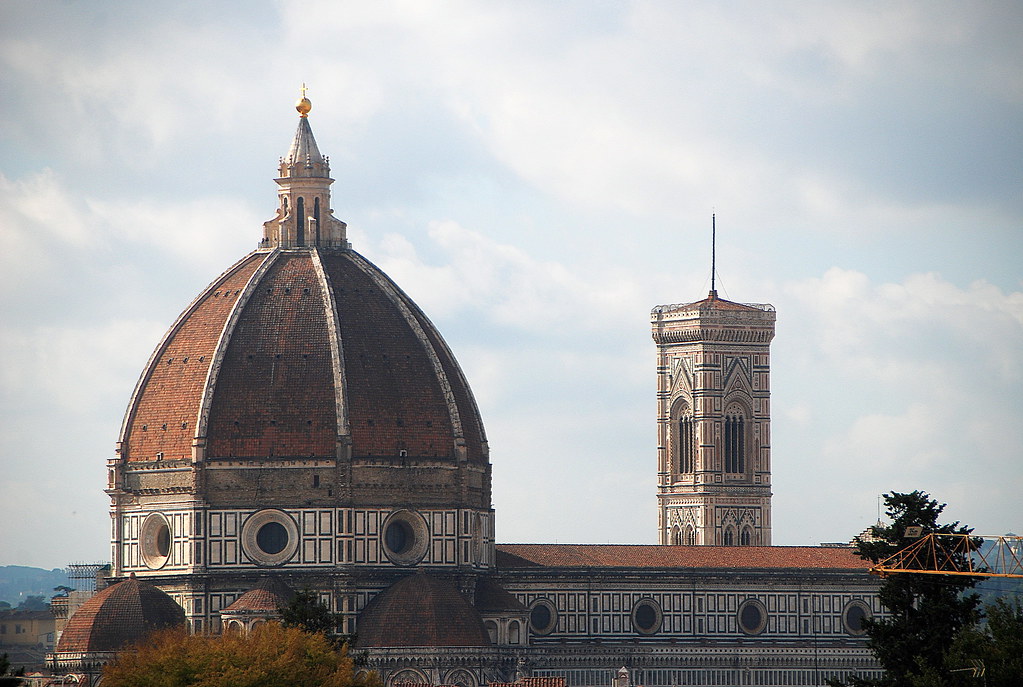
Brunelleschi's dome is one of the most important technical innovations of early modern architecture. Built during an era of reformation and proclaimed "renaissance," Brunelleschi's dome was a seminal architectural invention in terms of how it inspired the future construction of not only domes, but a myriad of other architectural pieces. For instance, Brunelleschi's influence on the Italian Jesuit architect and priest Marcos Guerra is one of explicit notability. In Guerra's design of the Compañía de Jesús in Quito, Ecuador, we see how Brunelleschi's successors were inspired by his radically new reinvention of the cupola in the Cathedral of Santa Maria del Fiore, Florence, to design their own visionary new domes.
The practical construction of Brunelleschi's dome involved a multiplicity of new technological advancements, most notably Brunelleschi's creation of an ox-driven hoist. His analysis of the classical architect and engineer Vitruvius indicates that he was looking back to antiquity to discover how he could further reinvent and develop the creations of such a renowned figure. In Brunelleschi's Dome, Ross King asserts that "in De architectura the Roman architect Vitruvius describes a treadmill turned by 'tramping men,' presumably slaves." King goes on to conclude that this contraption, created by Vitruvius, was somewhat adapted by Brunelleschi, who similarly powered his hoist through muscular strength — but through the strength of oxen instead. By adapting classical engineering designs, Brunelleschi radically propelled the means by which buildings could be constructed, expediting the creation of innovative new architecture, as an ox-driven hoist could lift significantly more weight than a human-powered one. In the design of the ox-hoist, Brunelleschi also added a reversible gear — a seminal innovation, with no known precedent in the history of engineering. The ox-hoist was, as a result, hugely influential for Renaissance architects and inspired others to adopt similar mechanisms for their own dome constructions.
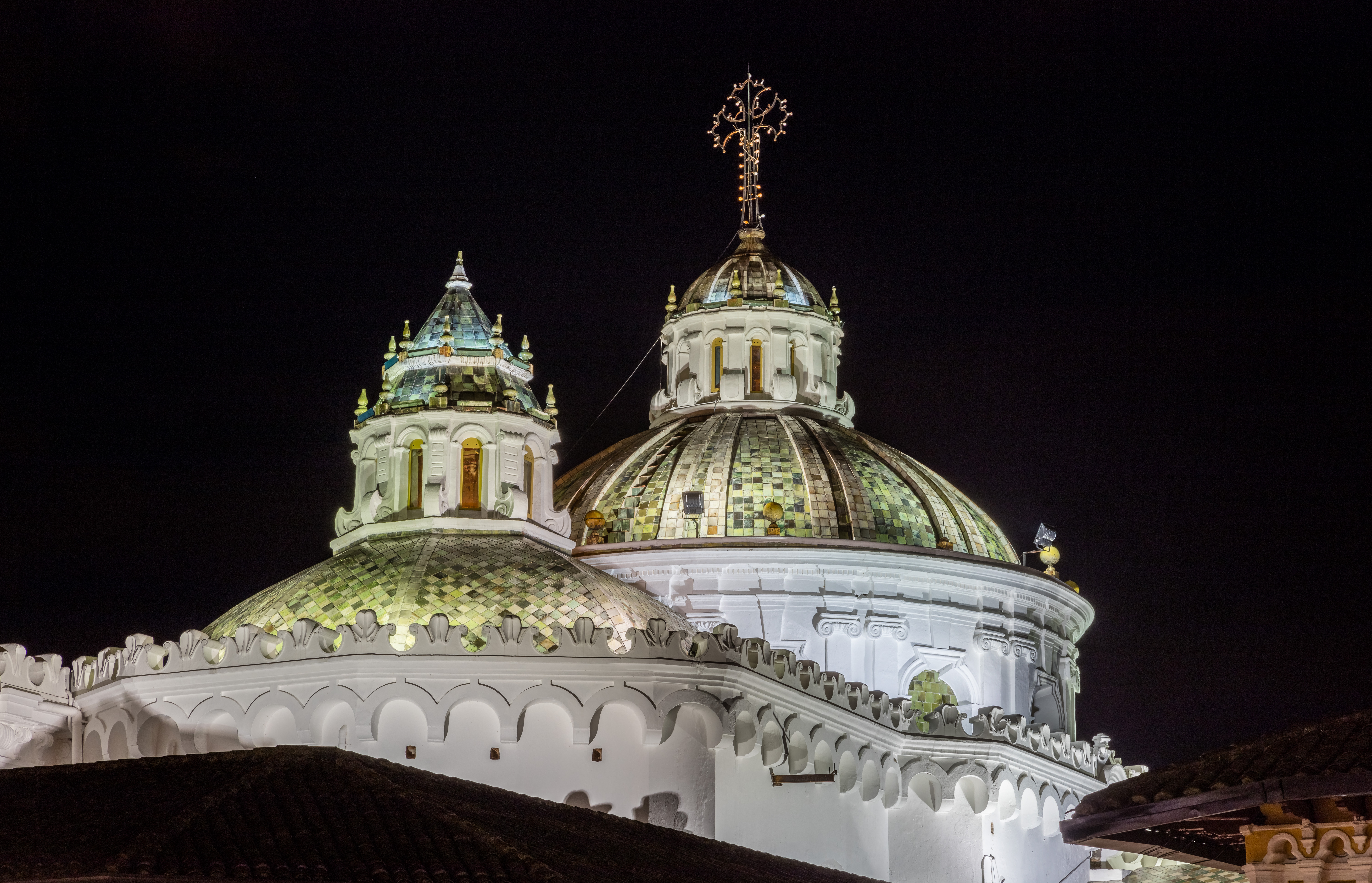
For Marcos Guerra, his inspiration from Brunelleschi's dome is exemplified in the main, largest dome of the Compañía de Jesús. Although the cupola's diameter is significantly smaller than that of Brunelleschi's — at 26 metres — it was intended to serve a similar ritualistic purpose for the church as a building. Its placement directly above the crossing, between the nave and the transepts, allows the laity to observe the frescoes in its concave surface during worship. Prior to Brunelleschi, architects of the Gothic period had been more fixated on the construction of vaults than domes, having struggled to revive the Roman tradition of domes for centrally planned churches. Many have argued that Brunelleschi held Trecento architects in contempt, and instead sought inspiration from classical architects such as Vitruvius to help shape the future of classically-based architecture.
Brunelleschi undeniably influenced the creation of even more original and innovative dome designs. In the Compañía de Jesús, it becomes evident how later architects capitalised on Brunelleschi's feats of engineering — most importantly, the ribbing of the dome as a means of structural support. The presence of eight ribs in the dome illustrates how fundamental ribbing had become to dome construction; an idea arguably born from a hybrid of Byzantine domes and Gothic ribbing.
However, on closer observation of the structure of Guerra's dome, it is evident he did not seek simply to replicate Brunelleschi's design, but rather to inherit its fundamental architectural features while drawing on elements from other artistic periods. For example, since the ribs of the octagonal drum of Brunelleschi's dome continue downwards, sustaining the basic shape of the central nave, there is no need for pendentives at the base of the dome. The Compañía de Jesús, by contrast, arguably reflects a hybrid of Byzantine and Early Renaissance architecture: Guerra's inclusion of pendentives below the dome demonstrates that while Brunelleschi undeniably shaped the domes that followed him, architects working in periods such as Late Antiquity and the Roman era also remained a live source of inspiration long after their own time. Yet Guerra also designed his dome with an octagonal drum, even as other Baroque architects were beginning to increase the number of ribs — Michelangelo's dome for St Peter's Basilica in Rome, for instance, increased the rib count to sixteen. Guerra's decision to retain eight ribs reinforces the sense that he was directly influenced by Brunelleschi. Another reason for the structural brilliance of Brunelleschi's dome was his use of the mathematical concept of quinto acuto — pointed fifths. To produce a dome that adhered to this concept, each corner had to share an identical curvature, so that all eight ribs met precisely at the top. Guerra appears to follow this same mathematical principle in the curvature of his own dome. Brunelleschi's use of quinto acuto proved hugely influential for his successors, as it reinforced the dome structurally by decentralising and evenly distributing its weight. Although the dome of the Compañía de Jesús is smaller in height than that of Santa Maria del Fiore, Guerra's fidelity to Brunelleschi's engineering principles suggests just how influential Brunelleschi's structural achievements remained for architects working long after his lifetime.
To understand Guerra's stylistic and aesthetic influences in designing the Compañía de Jesús, it helps to consider the newly established Jesuit order alongside it. The order believed that Italian-looking churches would help the Catholic population of South America feel a closer sense of unity with the Catholic Church in Italy. By the sixteenth century, Italy's cultural influence in cities such as Quito had already begun to spread widely. Marcos Guerra, a Jesuit priest working as a missionary in Ecuador, was himself disseminating Italian culture. Stylistically, the grandeur associated with Brunelleschi's dome is clearly echoed in Guerra's — for instance, in his addition of a lantern atop the dome, which lends it greater height and transforms it into something of a beacon, allowing worshippers to recognise the church from a distance. Since this church exhibits Baroque characteristics, it illustrates how Guerra and his architectural contemporaries were collectively finding new ways to reinvent the dome. The protruding exterior ribs, running towards the lantern at the dome's peak, emphasise how mature and sophisticated the Baroque style had become by this point. Guerra's use of green tiles, meanwhile, shows how architects of the period were experimenting with new materials to establish their own individual styles.
Brunelleschi's dome also exemplifies remarkable engineering and mathematical ingenuity. Although its eight ribs were constructed individually in different workshops, Brunelleschi's exacting standards meant each segment had to be measured to precisely the correct size, ensuring that all eight ribs would meet at a single central point at the top of the dome. To achieve this, Brunelleschi used eight pine templates as a means of "partial centering," helping to secure the ribs in relation to one another — a method that proved remarkably successful, given that the ribs, despite being built in separate workshops, came together almost faultlessly. The dome's construction relied on a range of complex engineering techniques: each individual brick had to be placed with precision so that the weight of the structure was distributed harmoniously, with every horizontal layer of brick or stone measured exactly as the dome gradually contracted toward its apex. In The Life of Brunelleschi, the art historian Manetti describes Brunelleschi as "undoubtedly the most prominent architectural figure of the fifteenth century." Yet Manetti also complicates the picture of Brunelleschi's influence, noting that he "leaves only rough models, easily misunderstood." This suggests that the cupola's original blueprints were never made available to other architects, meaning many would have remained unaware of techniques such as Brunelleschi's herringbone brickwork pattern, which reinforced the stability of the dome's weight distribution.
Since the blueprints for Brunelleschi's dome were destroyed, later architects such as Guerra had to interpret its qualities according to their own understanding. Guerra's dome for the Compañía de Jesús is unmistakably Baroque in character, yet — much like Brunelleschi's — it also looks back to classical architecture for inspiration. Arguably, Brunelleschi's dome did more than inspire further domes: it also helped spur a broader rise in individualism and humanism in architecture. As Leader Scott put it, "after Brunelleschi's grand strike for freedom, artists dared to stand alone, and the builders of the Renaissance shined out as separate men whose distinctive minds are impressed on their buildings."
Brunelleschi's dome, then, stands as one of the most important and influential technical innovations of early modern architecture. While Marcos Guerra's design for the Compañía de Jesús drew partly on Byzantine tradition — most notably in his use of pendentives — his retention of an octagonal drum shows how strongly he and his contemporaries were shaped by Brunelleschi's use of ribbing, both to stabilise the dome structurally and to enhance its visual appeal. Brunelleschi's ability to revive the dome, despite its relative absence during the Gothic period, reflects his own drive toward innovation and originality. Guerra's continued use of quinto acuto likewise shows how enduring and influential this reinforcing technique remained long after Brunelleschi's death, underscoring his lasting influence on later architecture. Had Brunelleschi never built his dome for Santa Maria del Fiore, it is reasonable to think that domes might never have become so architecturally widespread.
Bibliography
Arte Historia, Iglesia de la Compañía de Jesús, retrieved from http://www.artehistoria.com/v2/obras/10229.htm
Bailey, Gauvin Alexander, Art on the Jesuit Missions in Asia and Latin America, 1542–1773 (University of Toronto Press, 2001), p. 38
Bailyn, Bernard, and Denault, Patricia L., Soundings in Atlantic History (Harvard University, 2009), p. 199
Conway, Hazel, and Roenisch, Rowan, Understanding Architecture: An Introduction to Architecture and Architectural History (Routledge, 2005), p. 78
Fundación Iglesia de la Compañía, Jewel of the Baroque, retrieved from http://www.fundacioniglesiadelacompania.org.ec
Johnson, J. L., review of La Cultura Hispano-Italiana de Los Jesuitas Expulsos, by Miguel Batllori, Vol. 52, No. 1 (American Association of Teachers of Spanish and Portuguese, 1969), p. 147
Jones, Barry, Sereni, Andrea, and Ricci, Massimo, Building Brunelleschi's Dome: A Practical Methodology Verified by Experiment (University of California, 2010), pp. 39–61
King, Ross, Brunelleschi's Dome (New York: Vintage, 2000), p. 58
Manetti, Antonio, Life of Brunelleschi (Penn State, 1968), pp. 29–30
Melaragno, Michele, An Introduction to Shell Structures: The Art and Science of Vaulting (Springer, 1991), p. 65
O'Malley, John W., The Jesuits: Cultures, Sciences, and the Arts, 1540–1773, Volume 1 (University of Toronto Press, 1999), p. 296
Piñas, P. Francisco, El Arquitecto Hermano Marcos Guerra (2008), p. 29
Prager, Frank D., and Scaglia, Gustina, Brunelleschi: Studies of His Technology and Invention (Dover, 2004), p. 11
Scott, Leader, Great Masters in Painting and Sculpture: Brunelleschi (London: G. Bell, 1901), pp. 61, 147
Nathan Charles Czapnik